
Your brakes usually give you warning signs before something goes wrong. A faint squeal, a softer pedal, or a steering wheel that vibrates when you slow down can point to a problem that needs attention. Spotting these signs early can help you avoid more extensive repairs.
This guide covers how your brake system works, what each symptom points to, and what inspection, pad replacement, rotor work, and fluid service involve. Drivers in Steamboat Springs and the Yampa Valley face added strain from steep grades and long winters, so one section focuses on what mountain conditions do to brakes and how to plan around them.
- Most vehicles use disc brakes on the front axle and either disc or drum brakes on the rear, all powered by hydraulic pressure.
- Squealing, grinding, a soft pedal, pulling, and vibration each point to a different brake component.
- Brake fluid absorbs moisture over time, lowering its boiling point and raising the risk of brake fade on long descents.
- Rotors can be resurfaced only if they stay above the manufacturer’s minimum thickness after machining.
- US 40 over Rabbit Ears Pass reaches a 6.8% grade, and Colorado’s winter de-icers speed up corrosion on calipers, lines, and hardware.
- A quick brake check at every tire rotation, plus a full wheels-off inspection each year, catches most problems while repairs are still minor.
How Do Brakes Work?
Pressing the pedal pushes a piston inside the master cylinder, which forces brake fluid through a network of lines to each wheel. Fluid doesn’t compress, so the force from your foot arrives at the wheels instantly, multiplied by the brake booster and the hydraulic design. At each wheel, that pressure squeezes friction material against a spinning metal surface and turns the vehicle’s motion into heat.
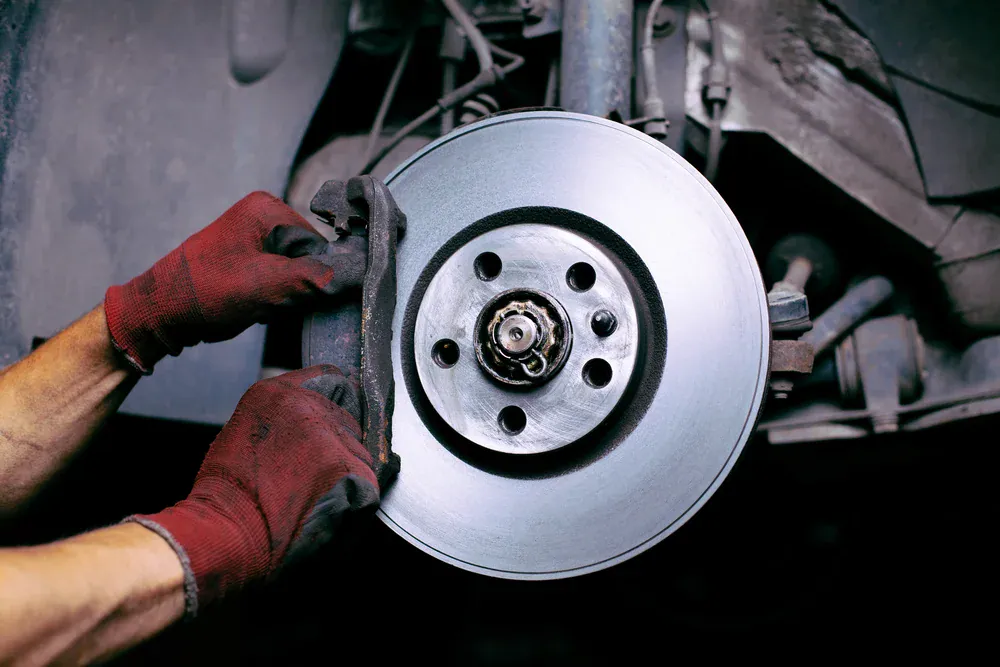
Disc brakes use a caliper to clamp two pads against a rotor attached to the wheel hub. The open design sheds heat quickly and resists fade, which is why nearly every modern vehicle uses discs up front, where weight shifts during a stop and most of the braking happens.
Drum brakes press curved shoes outward against the inside of a metal drum. They cost less to build and still appear on the rear axle of many trucks and economy cars, but they trap heat and lose effectiveness faster under sustained braking. An anti-lock braking system (ABS) sits on top of either setup, pulsing pressure to keep the wheels from locking during hard stops.
Brake Pads
A pad is a steel backing plate with friction material bonded to one side. Organic pads run quiet but wear quickly, semi-metallic pads handle heat well at the cost of more noise and dust, and ceramic pads offer long life with little dust. Many pads include a small metal tab that scrapes the rotor once the friction material wears thin, producing the squeal most drivers recognize.
Brake Rotors
Rotors are iron discs that spin with the wheel and absorb the heat of every stop. Most front rotors are vented, with internal fins that pull air through the center to cool faster. Each rotor has a minimum thickness stamped on it; below that point, it can no longer manage heat safely.
Brake Calipers
The caliper holds the pads and houses one or more pistons that push them against the rotor. Most passenger vehicles use floating calipers, which ride on lubricated slide pins, while performance vehicles often use fixed calipers with pistons on both sides. A seized pin or piston keeps a pad dragging, which wears it unevenly and overheats that wheel.
Brake Fluid and Lines
Most vehicles use glycol-based fluid (DOT 3, DOT 4, or DOT 5.1), which absorbs moisture from the air through hoses and the reservoir vent. Within about a year, most fluid picks up roughly 2% water, enough to drop its boiling point by around 75 degrees. Steel lines carry that fluid along the underbody, and flexible rubber hoses connect to each wheel; steel corrodes over time, while rubber cracks or swells internally.
Warning Signs Your Brakes Need Attention
Each symptom tells you something specific:
- High-pitched squeal when braking: The wear indicator is touching the rotor. Schedule service soon.
- Grinding or scraping: The friction material is gone and metal is scoring the rotor. What could have been a pad replacement is now a rotor job too, so stop driving as soon as possible.
- Soft, spongy, or sinking pedal: Air or moisture in the fluid, a leak, or a failing master cylinder. Treat this as urgent.
- Pulsing pedal or shaking steering wheel: Uneven rotor thickness, usually caused by heat. Often called “warped rotors.”
- Pulling to one side: A sticking caliper, a collapsed brake hose, or contaminated pads. Rule out a wheel alignment [URL] issue as well.
- Burning smell after a descent: Overheated brakes or a dragging caliper.
- Brake or ABS warning light: Low fluid, a sensor fault, or a parking brake left engaged.
- Wet spots near a wheel or on the inside of a tire: A fluid leak at a caliper, hose, or wheel cylinder.
Anything that changes how the pedal feels needs same-day attention. Noises usually leave a short window to book an appointment.
What a Professional Brake Inspection Covers
A real brake inspection means pulling the wheels, not glancing through the spokes. A technician should check:
- Inner and outer pad thickness at every wheel, since uneven wear between the two often signals a caliper problem
- Rotor thickness, runout, and surface condition, including scoring, cracks, heat spots, and rust
- Caliper pistons, slide pins, and seals for smooth movement and leaks
- Brake hoses and steel lines for cracks, bulges, and corrosion
- Fluid level and moisture content, measured with a test strip or electronic tester
- Shoes, wheel cylinders, and hardware on drum-equipped vehicles
- Parking brake operation
- A road test for pedal feel, pulling, noise, and ABS function
You should leave with measurements, not just a pass or fail. Pad thickness in millimeters, rotor readings against spec, and photos of worn parts give you what you need to make a confident decision about repairs.
1-Off Auto Center’s ASE-certified technicians measure every pad, rotor, and line, then walk you through the findings before any work begins. As a NAPA AutoCare Center, covered repairs carry a nationwide warranty.
Brake Pad Replacement: When and Why
Most manufacturers recommend new pads once the friction material reaches about 3 to 4 millimeters. Replacing them before the wear indicator starts squealing for weeks protects the rotors, which are far more expensive to replace than pads.
A proper brake pad replacement includes more than swapping parts:
- New pads on both wheels of the same axle so braking stays even side to side
- Cleaned and lubricated slide pins, plus new hardware clips where needed
- Rotor measurement to decide whether they can stay, be resurfaced, or need replacing
- Bedding the new pads with a series of controlled stops, which lays an even layer of pad material onto the rotor for smooth, quiet braking
Pad choice matters more in the mountains. A daily commuter does well with a quality ceramic pad, while a truck that tows or regularly descends long grades benefits from a compound rated for higher temperatures.
Rotor Resurfacing vs. Replacement
Resurfacing, also called machining or turning, shaves a thin layer off each side of the rotor to restore a flat, smooth surface. That only works if enough metal remains.
| Resurface when the rotor… | Replace when the rotor… |
|---|---|
| Stays above minimum thickness after machining | Is at or below minimum thickness, or would be after machining? |
| Has light scoring or minor thickness variation | Has cracks, deep grooves, or blue heat spots |
| Shows only light surface rust | Has rust pitting on the braking surface |
Many modern rotors leave the factory thinner and lighter than older designs, with little material to spare. Machining costs can also come close to the price of a new rotor, so replacement is often the more practical choice. A thinner rotor holds less heat, which matters on long mountain descents.
Caliper and Brake Fluid Service
Caliper problems tend to show up as a vehicle that pulls, one wheel noticeably hotter than the others after a drive, or a pad worn much faster on one side. Service ranges from cleaning and lubricating seized slide pins and replacing torn boots to installing a remanufactured caliper when a piston or seal has failed.
A brake fluid flush pushes fresh fluid through each wheel circuit until all the old fluid is out, then bleeds any trapped air. Most manufacturers call for a fluid change every two to three years. Moisture lowers the boiling point and also corrodes parts inside the system, including caliper pistons and the ABS module, which is one of the most expensive brake components to replace.
How Mountain Driving and Colorado Winters Affect Your Brakes
US 40 over Rabbit Ears Pass reaches a 6.8% grade, and the westbound side drops about 2,467 feet over roughly 7.5 miles into the Yampa Valley. Holding the pedal down that entire stretch builds heat faster than rotors can release it. Combine that heat with moisture-heavy fluid and the fluid can boil, leaving a pedal that sinks with little stopping power.
CDOT’s mountain driving advice is to shift into a lower gear before starting downhill and let the engine slow the vehicle, rather than riding the brakes. Firm, short brake applications followed by release keep temperatures lower than steady light pressure. Trucks pulling trailers and lifted 4x4s on oversized tires, add weight beyond what factory brakes were designed for, so they need the most attention.
Winter brings a second problem. Colorado relies heavily on magnesium chloride for road de-icing, and a 2002 CDOT research study examined its corrosive effects on vehicle components. Mechanics in Colorado mountain communities report the worst brake corrosion on the passenger side, where tires run through de-icer that pools along the road’s edge. The result shows up as seized slide pins, rusted rotor surfaces, corroded steel lines, and stuck bleeder screws.
Regular undercarriage washes through the winter slow that damage. A brake inspection in fall, before snow arrives, and again in spring, after de-icing season ends, catches corrosion before it seizes a caliper or eats through a line. 1-Off also handles diesel truck service for heavier rigs that work these grades daily.
How Often Do I Need to Have My Brakes Checked?
For most drivers, a visual brake check at every tire rotation or oil change, plus a full wheels-off inspection once a year, is enough. Mountain driving and winter road treatments justify more frequent checks.
| Situation | Recommended check |
|---|---|
| Normal daily driving | Visual check at each tire rotation or oil change; full inspection yearly |
| Regular mountain passes, towing, or heavy loads | Full inspection twice a year, in fall and spring |
| After a hard descent with a burning smell | Inspection before your next long drive |
| Brake fluid | Moisture test yearly; replace per manufacturer schedule |
| Any warning sign above | Inspection right away |
FAQs
How long do brake pads last?
Most pads last somewhere between 30,000 and 70,000 miles, but driving conditions shift that number a lot. Stop-and-go traffic, frequent mountain descents, towing, and aggressive braking all shorten pad life, while steady highway driving extends it. Front pads typically wear faster than rear pads.
Why do my brakes squeak in the morning and then stop?
Moisture overnight leaves a thin layer of surface rust on the rotors, and the first few stops scrape it off. This is normal, especially in wet or snowy weather. A squeal that continues all day points to worn pads or loose hardware instead.
Can I keep driving with squeaky brakes?
For a short time, usually. The wear indicator is designed to give you a warning period before the pads are gone. Once squealing turns into grinding, continued driving damages the rotors and can reduce stopping power.
Should all four brakes be replaced at the same time?
Not usually. Brakes are serviced by axle, and front pads often need replacing one or more times before the rears do. Both sides of the same axle should always be replaced together.
Do I need new rotors every time I replace my pads?
No. Rotors that are above minimum thickness, smooth, and free of pulsation can be reused. Rotors that are scored, cracked, or near their minimum need resurfacing or replacement for new pads to seat and perform correctly.
Schedule Brake Services in Steamboat Springs
For 17 years, 1-Off Auto Center has kept Yampa Valley drivers stopping safely, from daily commuters to diesel trucks that tow over Rabbit Ears. Our ASE-certified team works on foreign and domestic vehicles, gas and diesel, and serves drivers from Steamboat Springs, Hayden, Craig, Oak Creek, and Walden.
Call (970) 871-1346 or book a brake inspection and repair before your next trip over the pass.